
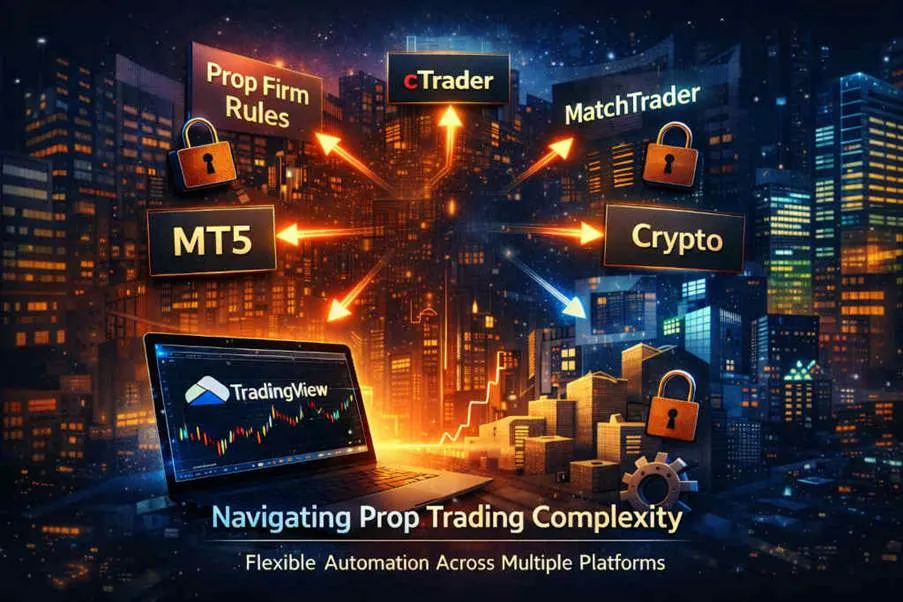
The prop trading market in 2026 is fragmented. One firm offers MT5, another pushes cTrader, another uses DXtrade, another Match-Trader or TradeLocker.
For traders building execution around TradingView alerts, that fragmentation is the real problem.
AlgoWay is built for exactly this environment: a multi-platform automation layer designed to route signals into the execution venue that is actually available to the trader.
AlgoWay publicly lists more than 20 supported platforms, including MT5, cTrader, DXtrade, Match-Trader, TradeLocker, Tradovate, ProjectX, and multiple crypto venues.
Platform support does not mean route availability
That sounds simple until you look at prop-firm rules.
A platform may support automation technically, yet the prop firm using that platform can still block the exact route you want.
- cTrader has an official Open API
- DXtrade publishes APIs
- Match-Trader offers a Platform API
- MetaTrader 5 is built around automated trading through EAs
But Match-Trader also states that, under a server-license setup, API functionality can be selectively disabled.
In other words, platform capability does not automatically mean practical route availability.
That is why AlgoWay’s value is not just “we support many platforms.”
The real value is route flexibility across different prop-firm environments.
In one case, MT5 may be the cleanest path.
In another, cTrader may be more workable.
In another, the firm may advertise a platform, but the external workflow required for TradingView automation may be partially restricted, manually controlled, or simply not worth deploying around.
In this market, the winner is not the trader who sees the most platform logos. It is the trader who finds a route that is actually usable, compliant, and stable.
FTMO: automation allowed, but within boundaries
A good example is FTMO.
FTMO publicly offers MetaTrader 4, MetaTrader 5, DXtrade, and cTrader.
At the same time, FTMO explicitly states that algorithmic trading is allowed, provided it stays within firm rules and does not violate forbidden trading practices.
That matters because it shows something important:
FTMO is not anti-automation.
The real filter is not whether automation exists, but whether the workflow remains legitimate under the firm’s own boundaries.
Alpha Capital Group: platform-specific restrictions matter
Alpha Capital Group is even more revealing because it publishes platform-specific restrictions in plain language.
Alpha says:
- EAs are allowed on MT5
- there is currently no EA functionality for cTrader, DX Trade, and TradeLocker accounts
- copy trading is permitted only under specific policies
- copy trading on or from cTrader, DX Trade, and TradeLocker accounts is not possible at this time
This is exactly the kind of rule split prop traders must understand.
Two firms may both advertise modern platforms, yet only one of them may support the route you actually need.
FundingPips: self-controlled automation vs third-party execution
FundingPips illustrates a different pattern.
Its terms say that:
- copy trading or account management by a third-party vendor is prohibited
- the use of a third-party Expert Advisor is allowed under conditions
At the same time, FundingPips’ cTrader listing says trade copying is permitted between FundingPips accounts belonging to the same individual.
That combination tells you everything about the modern prop landscape:
self-controlled automation may be acceptable, while third-party managed copying is not.
This is exactly why a trader cannot assume that one execution model will work the same way across every firm and every platform.
The same pattern appears across the market
This is not unique to one or two firms.
BrightFunded says copy trading is permitted only between accounts that belong to the same person.
FundedNext allows copy trading between your own Challenge Accounts under defined limits, but prohibits copy trading between different individuals and explicitly bans cloud-based copy tools such as Social Trader Tools or Duplikum in that context.
Fintokei says custom-built EAs developed and fully controlled by the trader are allowed, while copy trading and third-party bots the trader does not create or control are forbidden.
These firms are not banning technology as such.
They are filtering for:
- ownership
- control
- originality
The real problem is policy, not the webhook
This is where many traders get trapped.
They search for a platform first, then try to force their workflow into it.
But for prop trading, the platform is only half the story.
The other half is policy:
- Does the firm allow same-owner copying?
- Does it allow third-party EAs?
- Does it distinguish between self-managed automation and vendor-managed execution?
- Does it restrict the route on certain account types?
These questions decide whether an external TradingView pipeline is viable long before the webhook is even sent.
Where AlgoWay becomes important
That is where AlgoWay becomes important.
AlgoWay is not just a connector from TradingView to a single venue.
It is useful because prop traders do not live in a single-venue world anymore.
A trader may run:
- one evaluation on MT5
- another account on cTrader
- another challenge on a platform where the technical API exists but the usable route is narrower than expected
In that environment, what matters is not blind standardization.
What matters is being able to adapt your execution path to the reality of each firm.
Why broad platform coverage matters
That is also why broad platform coverage matters more now than it did a few years ago.
If a firm changes platform, changes rule interpretation, or restricts one route while leaving another open, the trader should not need to redesign the entire TradingView process from zero.
A flexible automation layer gives traders optionality.
It does not remove the need to follow the prop firm’s rules, but it does make it easier to shift toward the route that still works.
In a fragmented market, optionality is not a luxury.
It is operational survival.
The right question in 2026
The strongest way to think about prop automation in 2026 is this:
The question is no longer:
“Does this platform support automation?”
That is the wrong question.
The better question is:
“On this firm, on this account type, on this platform, is my exact workflow allowed and practical?”
Once you frame it that way, AlgoWay’s role becomes obvious.
It is not just a webhook endpoint.
It is a routing layer for traders navigating a prop ecosystem where:
- platform support
- policy support
- real-world usability
are no longer the same thing.
Final takeaway
For serious prop traders, that distinction matters.
The gap between “available on paper” and “usable in practice” keeps widening.
Some firms allow automation but only on one platform family.
Some allow copying but only between accounts owned by the same individual.
Some permit custom EAs but reject third-party managed execution.
Some expose a platform with official API capability, but the operator still controls whether that access is active in practice.
The traders who adapt to this reality will build more durable systems than the traders who keep assuming every platform works the same way.
That is the real pitch for AlgoWay in 2026:
Not just more connectors. Not just more logos.
A practical way to keep TradingView automation workable across a market where each prop firm has its own rules, its own platform mix, and its own view of what external execution should look like.
