

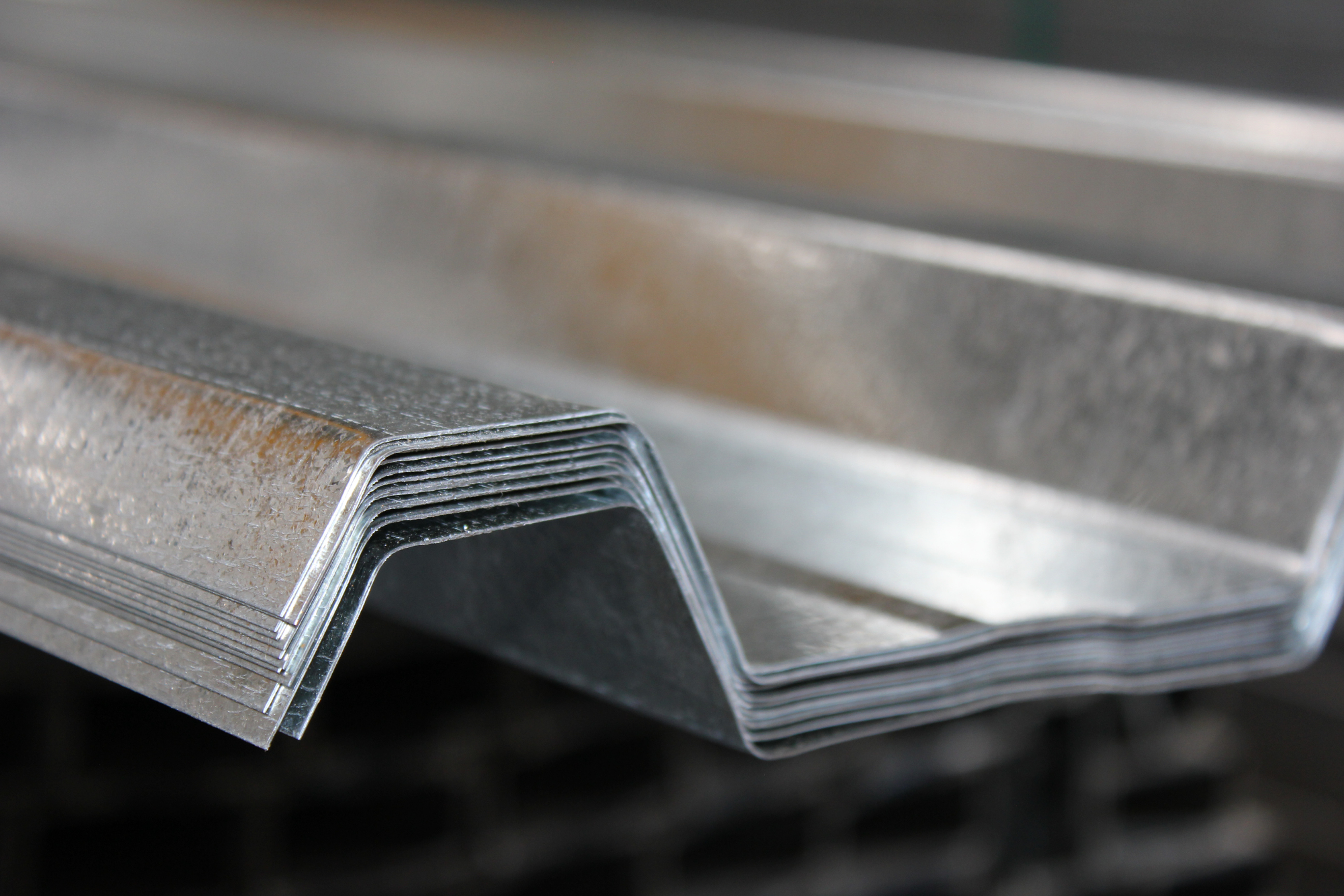
A common misconception in construction and sheet metal fabrication is that galvanized steel is completely immune to rust. While the zinc coating provides outstanding barrier and cathodic defense, galvanized steel sheets can and will rust under specific conditions.
Understanding why zinc protection breaks down—and knowing how to manage issues like “white rust” and exposed cut edges—is essential for maximizing the service life of galvanized installations.
1. How and Why Galvanized Sheets Rust
Galvanizing does not make steel rustproof; rather, it acts as a sacrificial shield that corrodes at a rate roughly $1/10text{th to }1/30text{th}$ as fast as bare iron.
Rusting occurs through two primary stages:
Stage 1: Consumption of the Zinc Shield (White Rust)
When galvanized sheets are exposed to moisture without circulating airflow (such as tightly stacked bundles stored outdoors), zinc reacts with water and trapped oxygen to form zinc hydroxide—a chalky white powder known as white rust or wet storage stain.
Note: Light white rust is purely a cosmetic surface phenomenon. However, if left unchecked in stagnant moisture, it rapidly consumes the zinc coating, leading directly to Stage 2.
Stage 2: Exposure of the Base Steel (Red Rust)
Once the zinc layer corrodes away completely in a localized area, atmospheric oxygen and moisture reach the carbon steel substrate, forming traditional iron oxide (red rust) ($Fe_2O_3$). From this point forward, the steel degrades at the same rate as ungalvanized metal.
2. The Cut Edge Phenomenon: Why Raw Edges Don’t Rust Immediately
When galvanized sheet metal is sheared, punched, or drilled on a job site, the cut edge leaves raw carbon steel directly exposed to the environment.
Zinc Coating (Anode) ──┐
│ [Galvanic Protection Zone]
┌───────────────────────┴────────────────────────┐
│ Base Carbon Steel Sheet (Cathode) │ ── Exposed Cut Edge
└────────────────────────────────────────────────┘
│
Zinc Coating (Anode) ──┘
Why don’t sheared edges rust right away?
-
Cathodic Edge Protection: Because zinc is more electrochemically active (anodic) than iron, an electrochemical cell forms across the edge in the presence of moisture. The surrounding zinc sacrifices itself to protect the exposed bare steel edge up to a distance of roughly $1.5text{ to }2.0text{ mm}$.
-
Limitation: On thick sheets ($>2.0text{ mm}$) or in heavy marine environments, the distance across the raw cut edge exceeds the protective throw of the sacrificial zinc, causing red rust to form along the seam.
3. Causes of Premature Galvanized Failure
-
Ponding Water: Standing water creates continuous anaerobic moisture contact, accelerating zinc depletion.
-
Contact with Acidic Soils or Harsh Chemicals: Environments with a $text{pH}$ below $4.0$ or above $12.0$ rapidly dissolve the zinc passive layer.
-
Galvanic Coupling: Direct contact with noble metals like copper or brass in the presence of moisture causes rapid, localized zinc destruction.
-
Enclosed Storage Stacking: Stacking wet sheets together traps moisture, causing severe white rust before installation even begins.
4. Practical Solutions & Prevention
|
Risk Factor |
Problem / Symptom |
Prevention & Repair Solution |
|
Wet Storage |
White rust / chalky powder |
Store bundles under cover at an incline; space sheets apart with timber dunnage to allow airflow. |
|
Field Cuts & Drills |
Exposed raw steel edges |
Spray cut edges with zinc-rich cold galvanizing compound (95% pure zinc dust). |
|
Ponding Water |
Surface zinc breakdown |
Ensure roof slopes have a minimum pitch of $1:12$ ($5^circ$) to guarantee complete water runoff. |
|
Fastener Contact |
Galvanic reaction at screw holes |
Use EPDM-washered fasteners with zinc-alloy or stainless steel heads. |
Summary Tip
When cutting galvanized sheets on site, avoid using high-speed abrasive cutoff wheels or angle grinders. The intense friction heat burns away the surrounding zinc coating and embeds hot iron sparks into the sheet face, causing premature rust spots. Always use cold-cutting shears, nibblers, or circular saws with non-ferrous carbide blades.
Aluminium Sheet Kampala Uganga
